Background
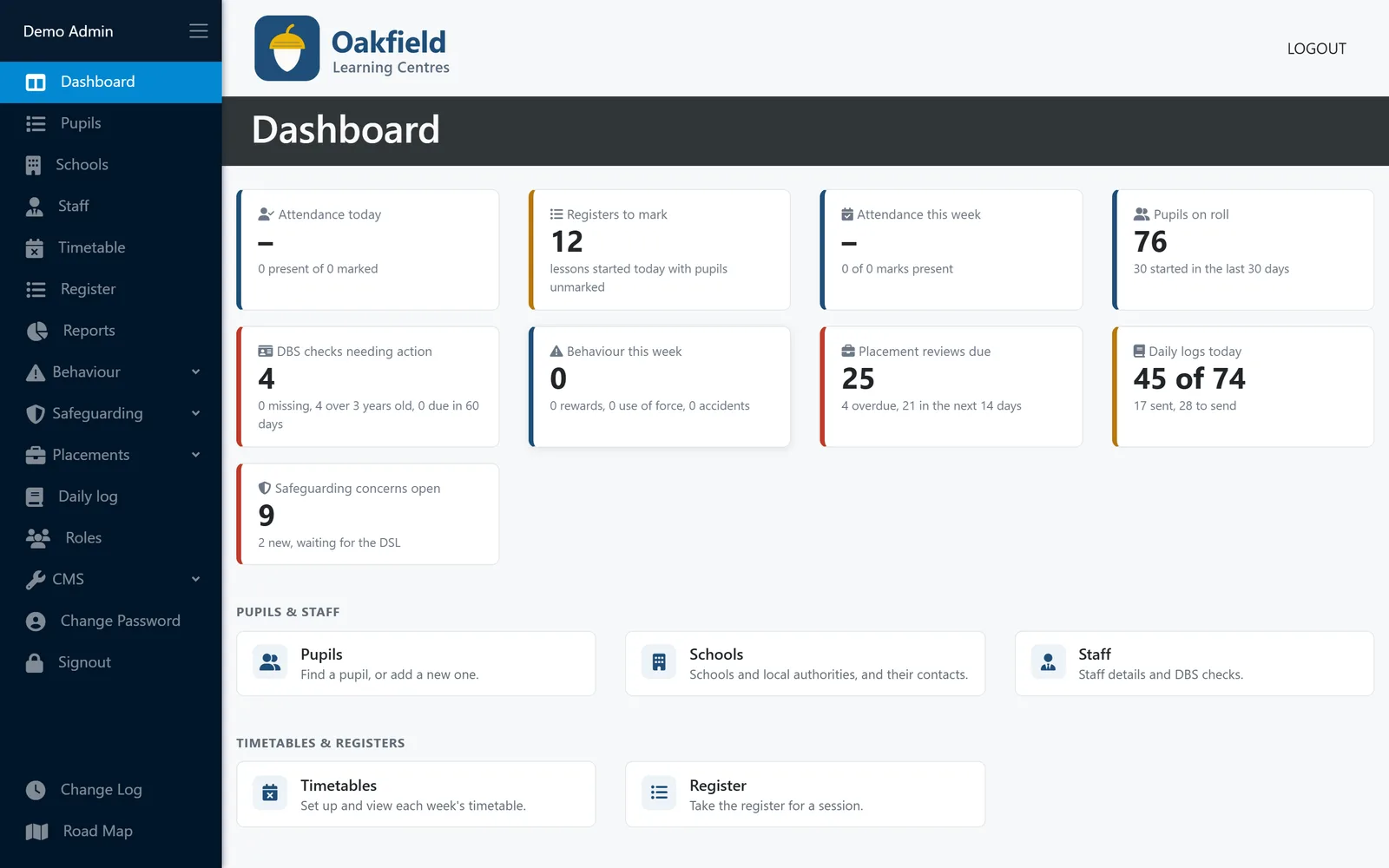
PupilDB is our own product: a pupil database for alternative provision providers, tuition centres, pupil referral units and small schools. It did not start life as a product, though. It started as a bespoke system for a multi-centre education provider that teaches pupils referred by schools and local authorities, and it has run their working day ever since.
Once the system had proved itself there, the obvious question was whether other providers who work the same way could use it too. PupilDB is our answer, and it is now live at pupildb.com.
The Challenge
Small education providers sit in an awkward gap. The big school management information systems are built for mainstream primaries and secondaries, with a price and a level of complexity to match. Spreadsheets are cheap and familiar, but they fall over quickly once you have several centres, a rota of tutors and pupils with medical needs.
The provider we built for had some very specific problems to solve:
- Pupils arrive by referral. Each one comes with a commissioning school or local authority, a number of entitled hours and a reason for being there, all of which need recording and reporting back.
- Teaching happens in small groups across several sites, so the timetable is a grid of teachers against time slots rather than classes against rooms.
- The pastoral load is heavy. Staff need medical notes, allergies, Looked After Child status, ALN or SEN details and transport arrangements to hand, not buried in a folder.
- Staff checks have to be provable. DBS dates, references, teacher registration and safeguarding certificates must all be kept in date.
Because the records are about children, many of them vulnerable, access control and data protection had to be right from the first day rather than added later.
What We Built
We built the application in C# and Blazor on SQL Server, hosted on Amazon Web Services in the EU (Ireland). It is organised as a set of modules, and each setting switches on only the ones it uses.
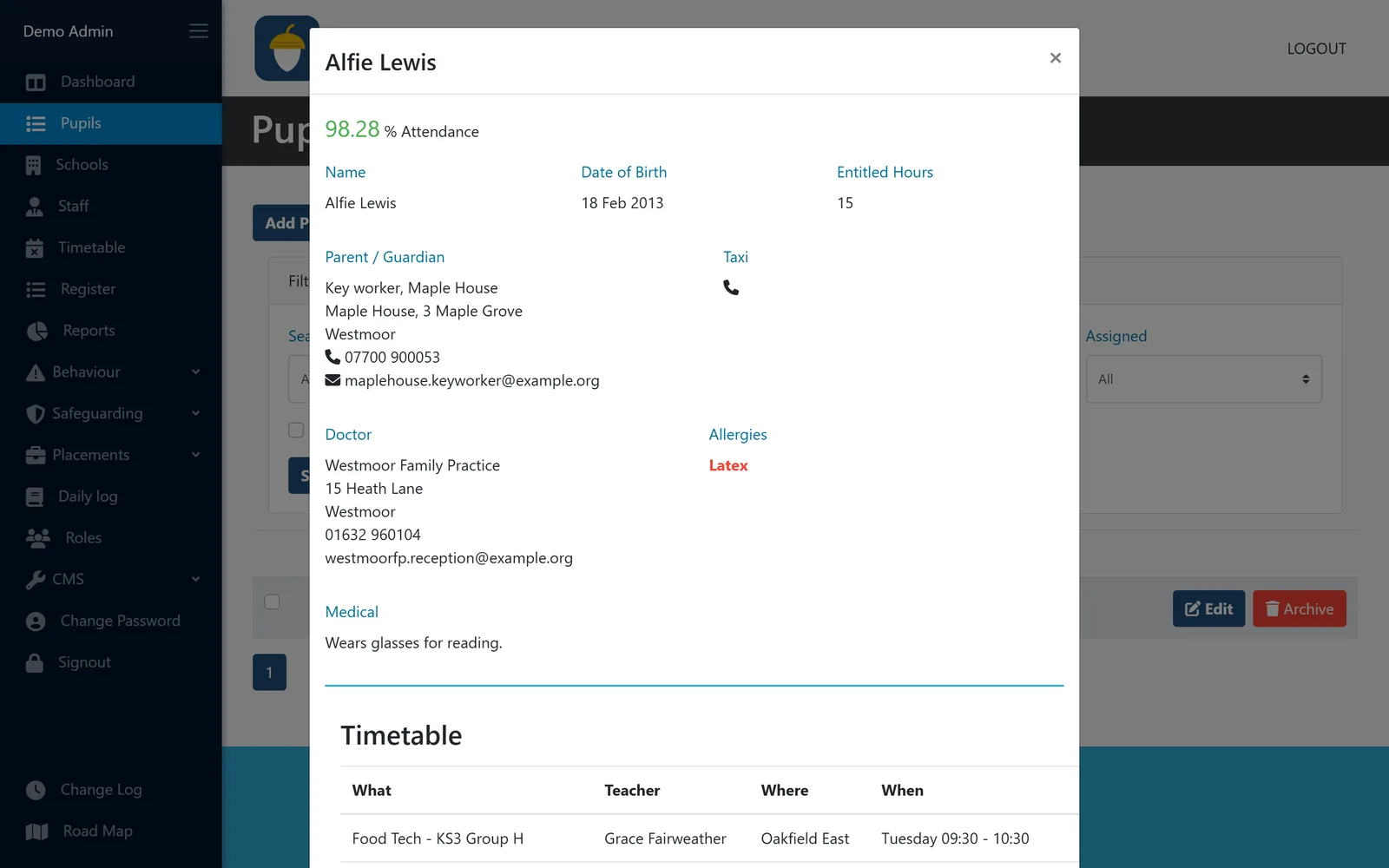
| Area | What it does |
|---|---|
| Pupil records | Contacts, placement details, medical needs, allergies, LAC status and ALN/SEN, with a one-click quick view |
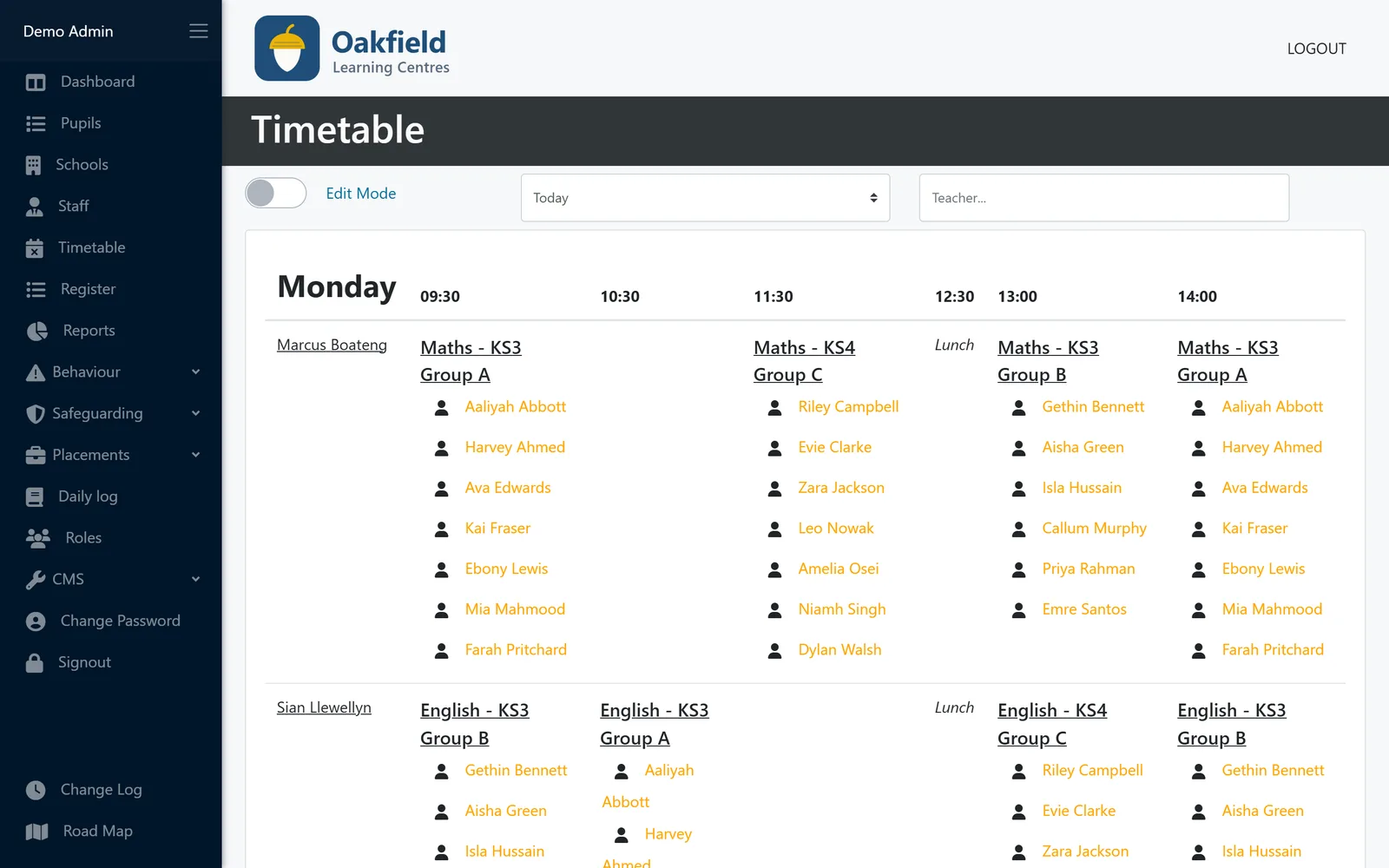
| Timetabling | A weekly grid of teachers and time slots across every centre, colour-coded by centre |
| Registers and attendance | Registers created from the timetable, a whole day marked in one go, and automatic chase-up emails for unfinished registers |
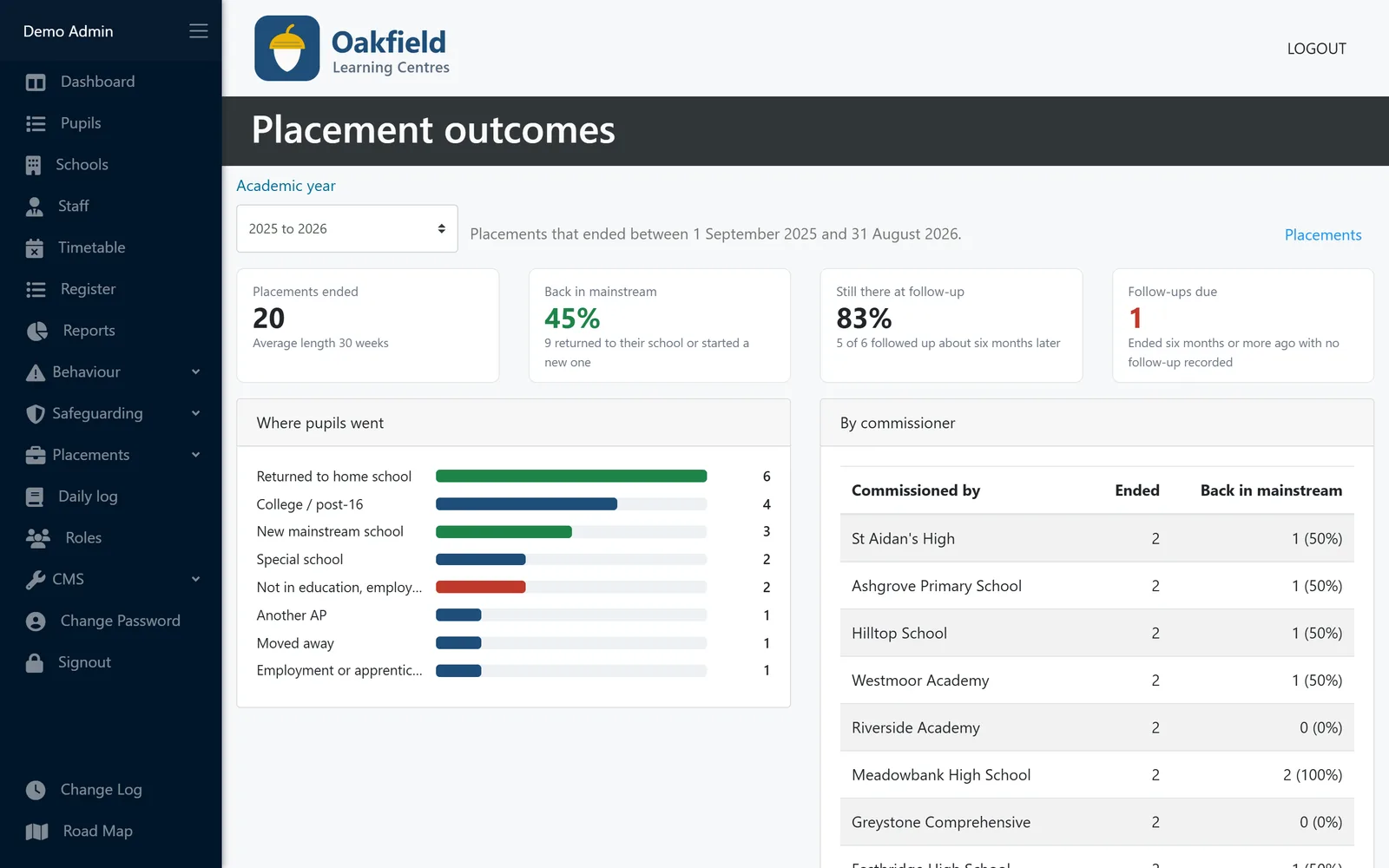
| Placements and outcomes | Who commissioned each placement and why, targets, six-weekly reviews, and where pupils go next |
| Daily log | Staff record how each pupil’s day went; a lead checks the reports and sends them to the commissioning school |
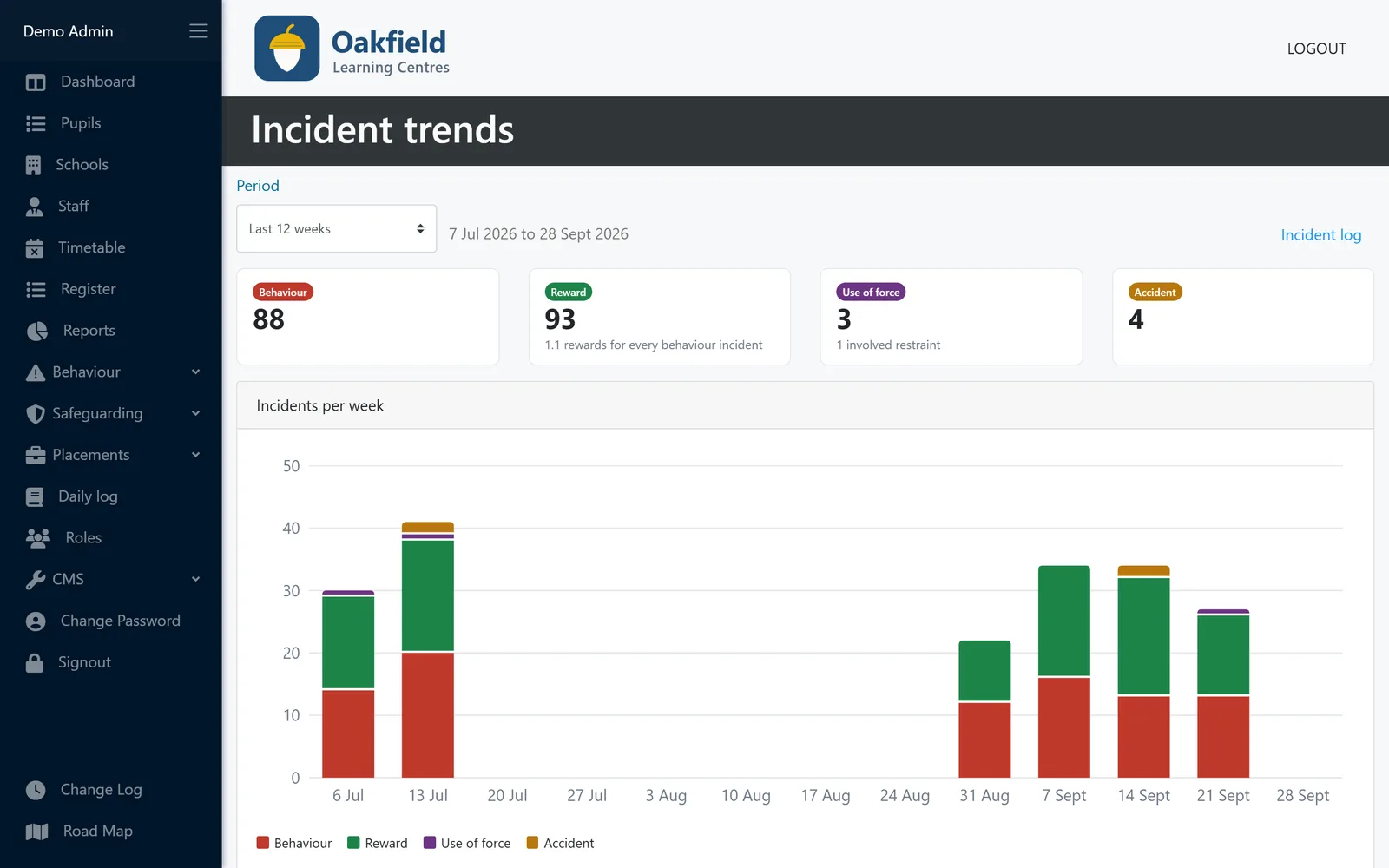
| Behaviour and incidents | Behaviour, rewards, accidents and any use of force in one log, with trends week by week |
| Safeguarding | Any member of staff can raise a concern; only the DSL and deputies can see and manage it |
| Staff compliance | DBS dates, references, teacher registration and certificates tracked per member of staff |
| Reports | Attendance against entitled hours, attendance by month, behaviour, and anonymised safeguarding figures for governors |
Key Technical Decisions
- The timetable drives the registers. A register is never typed up by hand. Pick a centre and a date and the right pupils are already listed, which is what turns registers from an hour’s job into a few minutes. A database constraint stops the same teacher being booked into one slot twice.
- Permissions follow the sensitivity of the data. Alongside the core administrator and teacher access, each module has its own permissions. Safeguarding is the strictest: concerns are visible to the DSL and deputies only, not to other administrators by default, and every record keeps a log of who has looked at it. Placement funding is hidden from anyone without the finance permission.
- Configuration instead of code changes. Absence reasons, local authorities, referral agencies, funding categories and the rest are lists each provider maintains for itself. Name, logo and colours are set per setting too, so the system looks like theirs.
- Reports shaped by the people who ask for them. Commissioners want attendance against entitled hours and a one-page summary for termly meetings. Governors want safeguarding figures without a single name. Finance wants to know what to invoice each school each month, exported as CSV for the accounts package.
Pricing and Roadmap
PupilDB is sold for a flat monthly fee from £150 + VAT, in broad size bands and never per pupil, so a small provider can budget for it without counting heads. Every band includes every feature.
We only market what the product does today. Anything still being built sits on a public roadmap, labelled as planned, and what customers tell us shapes what gets built next. The full feature list and pricing are on the PupilDB website.
The Outcome
The system is in daily use at the provider it was built with, handling their pupil records, timetables across several centres, registers, reports and staff checks. PupilDB takes that proven foundation and offers it to other providers in the same position, with published pricing and a roadmap that customers can influence.
For us, the project shows what a long-running bespoke build can grow into. Software written closely around one organisation’s real working day turned out to be exactly what a wider group of organisations had been missing. If you have a system that could become a product, or a sector that off-the-shelf software has overlooked, we would be glad to talk it through.
You can see PupilDB for yourself at www.pupildb.com.
Registers built from the timetable
Flat pricing from £150 a month + VAT
Hosted on AWS in the EU (Ireland)
Other Projects
Bristol Jobs
A regional job board platform serving the Bristol and South West employment market with targeted local recruitment.
Jobs Cast
A modern job board platform connecting employers with candidates through intelligent search and automated matching across multiple sectors.
Family Announcements
A community publishing platform for family milestones including births, marriages, and memorials, serving regional newspapers.